

Inside a Klate design.
One document holds the conversation, its branches, the systems behind each answer and the record of who agreed to it, from the first draft to sign-off.
The conversation,
turn by turn
A design reads like the conversation it describes, so anyone on the project can review it without learning a notation. Each agent turn carries a note on what it has to achieve and what it must not do, and reviewers judge the wording against that note.
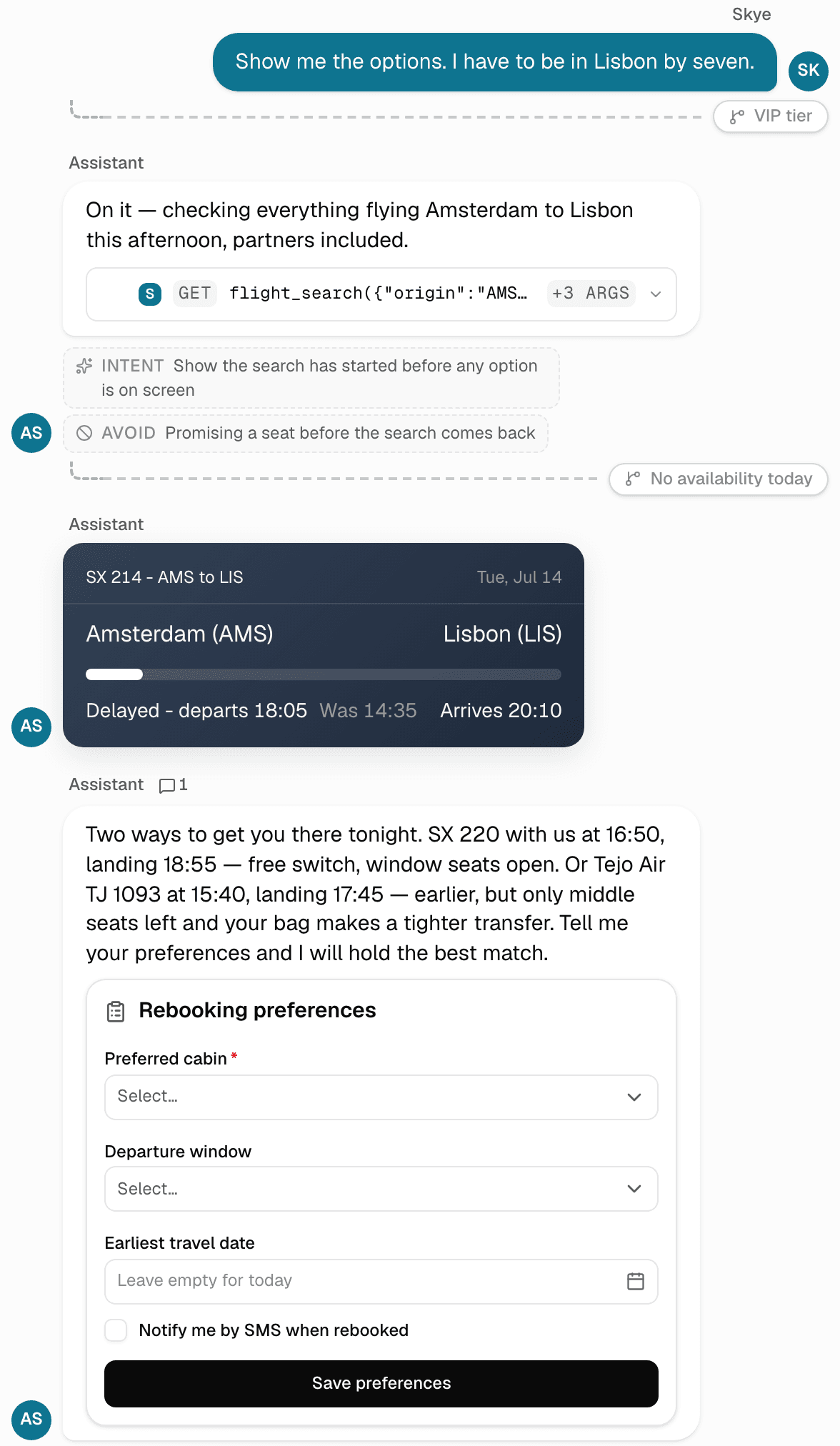
In this frame
- 1
Tool call
The lookup behind an answer, with example arguments.
- 2
Path marker
Where a branch forks off the main path. This one covers the day there is nothing to rebook onto.
- 3
Card
The flight status as the customer would see it, in the client’s brand.
- 4
Turn
The agent’s message, with a reviewer’s comment on it.
- 5
Form
The fields the agent collects, ready for the build team to read off.
Eleven kinds of block go in a turn: text, images, video, audio, files, code, citations, forms, cards, quick replies and tool calls.
One conversation,
many paths
The main path is the spine. From any turn you can fork a branch for the situations that need one: the answer is no, the system is down, the customer asks for a person. Branches can fork inside branches and rejoin where they resolve. Handing over to a person is an explicit ending with its own marker.
Every path is typed as happy, edge, sad or adversarial. A per-project coverage grid counts what has been designed against each scenario, so a gap is visible before someone meets it in production.
What engineering
builds from
Tool calls, cards, forms and behaviour rules are linked to the turns that use them.
Tool calls
Every answer that depends on a system names the tool behind it: example arguments, where each value comes from, and what the agent says when the call fails. Tools are specified once and reused across a client’s designs.
Cards and forms
When an answer is a card or a form, build it from a template, preview it in the client’s brand and reuse it across designs.
The Brief
One page per project: the goal, what the agent does and does not do, who it talks to, when it escalates and how it sounds. Behaviour rules sit beside it as When, Then, Why cards linked to the turns that demonstrate them.
From draft
to approved
A design moves through three phases, and each move is a recorded event with an actor, a timestamp and a note. Nobody needs to be in a meeting to review.
Collaboration
Invite people by email to one design or a whole client, as viewers or editors. Comments sit on the turn they are about, and a per-turn lock keeps two people from rewriting the same message.
Approvals
Send a design for sign-off to any email address. Approvers need no account: a private link, valid for fourteen days, opens the design read-only. Approved designs lock until someone deliberately reopens them.
Version history
Save a named checkpoint when a decision lands; Klate adds one at every phase change. Compare any version with its parent, turn by turn. Restore it in place, or fork it into a new draft.
Ask for a change,
review every edit
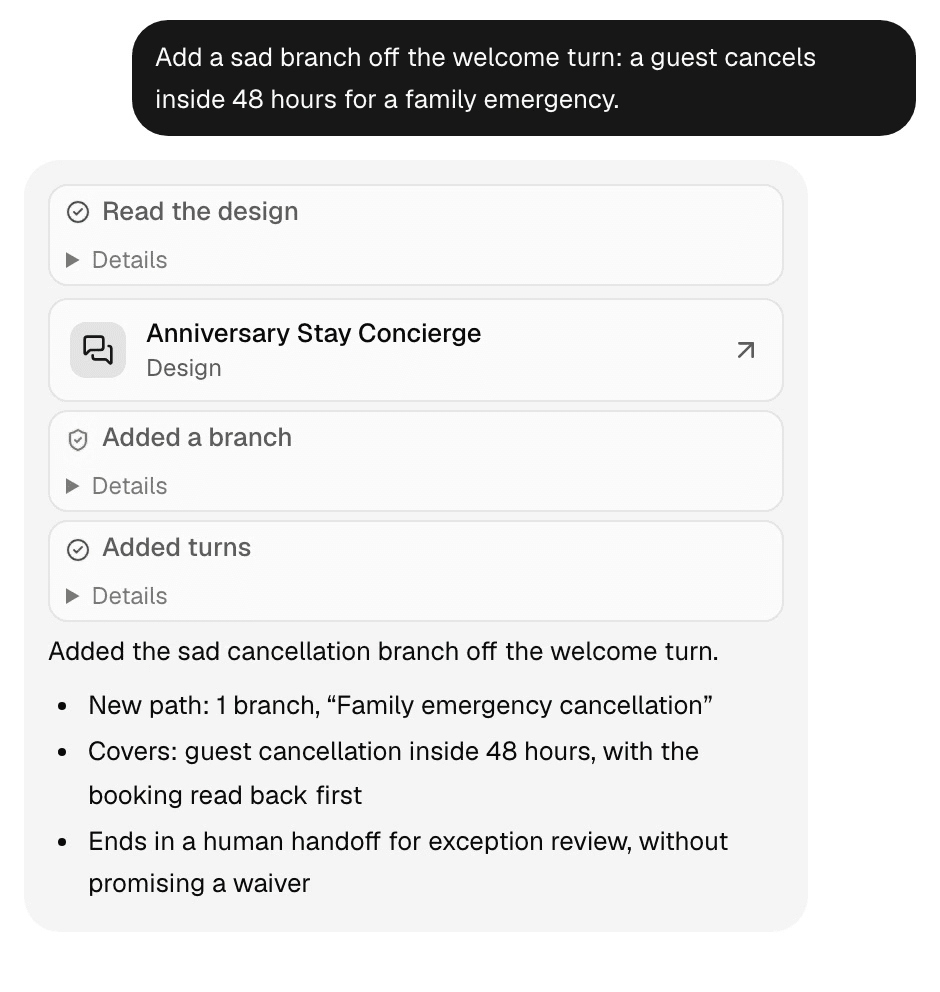
Ask Klate sits in a dock beside the editor and works the same surfaces you do: turns, branches, tools, forms and cards, the Brief, approvals. Tell it what you need and it makes the edits, showing each one before it lands, with your permissions and never more.
Bring your own AI
Point Claude, or any assistant that speaks MCP, at Klate and it reads and writes the same designs, behind the same permission checks as the app. In Claude, the Klate app renders that design in the chat while it works, so you review the document itself. Part of Pro and Team.
Paid plans include a monthly AI allowance. When it runs out, the assistant stops and your bill stays where it is.
The same decision, in five places.
A flight is running late, and somebody has to decide what the agent tells the passenger.
On a slide
Proactively notify passengers of disruption
Nobody can disagree with a bullet, so nothing in it is ever decided.
On a whiteboard
Boxes hold labels, not sentences. Nobody signs a whiteboard, and it goes stale the week the build starts.
In a spreadsheet
A row cannot show a conversation, so it always needs a second document, which soon disagrees with it.
In the agent builder
The most expensive room to have a design argument in. A change here costs a sprint and a re-test.
 In Klate
An example turn, and the note saying why
A design holds a full example of the turn: what happened, what it means for the customer and what they can do next, in that order. With it go the paths that open from this moment, and the designer’s note on what every version of the turn has to achieve and what it must not open with.
Start with a design of your own.
Klate opens to everyone soon. Send us a situation your agent should handle, and we will show you how it looks as a Klate design.